
A practical guide to Rongai, the only Kilimanjaro route approaching from the north, with advice on drier weather, pacing and the Mawenzi Tarn camp.
Rongai is the only established route that climbs Kilimanjaro from the north, starting close to the Kenyan border. Because the northern slopes sit in the mountain's rain shadow, it is generally drier than the southern routes, which makes it a sensible choice during the shoulder months and rainy seasons.
It is also one of the quieter trails. Climbers who want space, a gentle gradient and a different perspective on the mountain often find that Rongai suits them perfectly.
Quick tips
- Consider Rongai if you are climbing during the long or short rains.
- Choose an itinerary that includes the Mawenzi Tarn camp.
- Pack a warm hat and gloves even for day walking on the northern slopes.
- Expect a long drive to the start, so bring snacks and water.
- Use dry bags inside your duffel despite the drier climate.
Starting on the northern side
The climb begins at a gate near the village of Nalemoru, a long drive around the eastern flank of the mountain from Moshi. The early trail passes through farmland and pine plantation before entering a narrower belt of natural forest than you find on the southern slopes.
The forest section is short, so you reach open moorland quickly. Keep an eye out for colobus monkeys near the edge of the trees on the first day.
Because the drive to the gate is long, many groups set off from Moshi early in the morning. Your guide completes registration while you prepare your daypack, and the first day's walking is usually short and gentle, an easy introduction to life on the mountain.
Why the drier weather matters
Less rain means less mud underfoot, drier gear and clearer views on many days. During April, May, November and December, when the southern routes can be very wet, Rongai is often the more comfortable option.
Drier does not mean dry, though. Weather on Kilimanjaro is unpredictable at any time of year, so pack full waterproofs and protect your sleeping bag and spare clothes in dry bags.
Take the Mawenzi Tarn detour
Better Rongai itineraries include a night at Mawenzi Tarn, a small lake in a dramatic amphitheater beneath the jagged peaks of Mawenzi. It is one of the most striking campsites on the mountain and serves as an excellent acclimatization stop.
The seven-day version usually builds in this detour and gives more time to adjust before the high camp. Our team recommends it over the six-day option for most climbers.
- Take a short afternoon walk above the tarn to help acclimatize.
- Nights here are cold and still, so layer up before the sun drops.
- The tarn is a water source for camps, so keep it clean.
Crossing the Saddle to Kibo
From Mawenzi Tarn the trail crosses the Saddle, a high desert between Mawenzi and Kibo, to reach the high camp, typically Kibo Hut or a nearby campsite. Summit night then follows the same steep scree path as Marangu, via Gilman's Point to Uhuru Peak.
The Saddle can be windy and exposed. Wear your wind shell and keep sun protection on, even if the air feels cold.
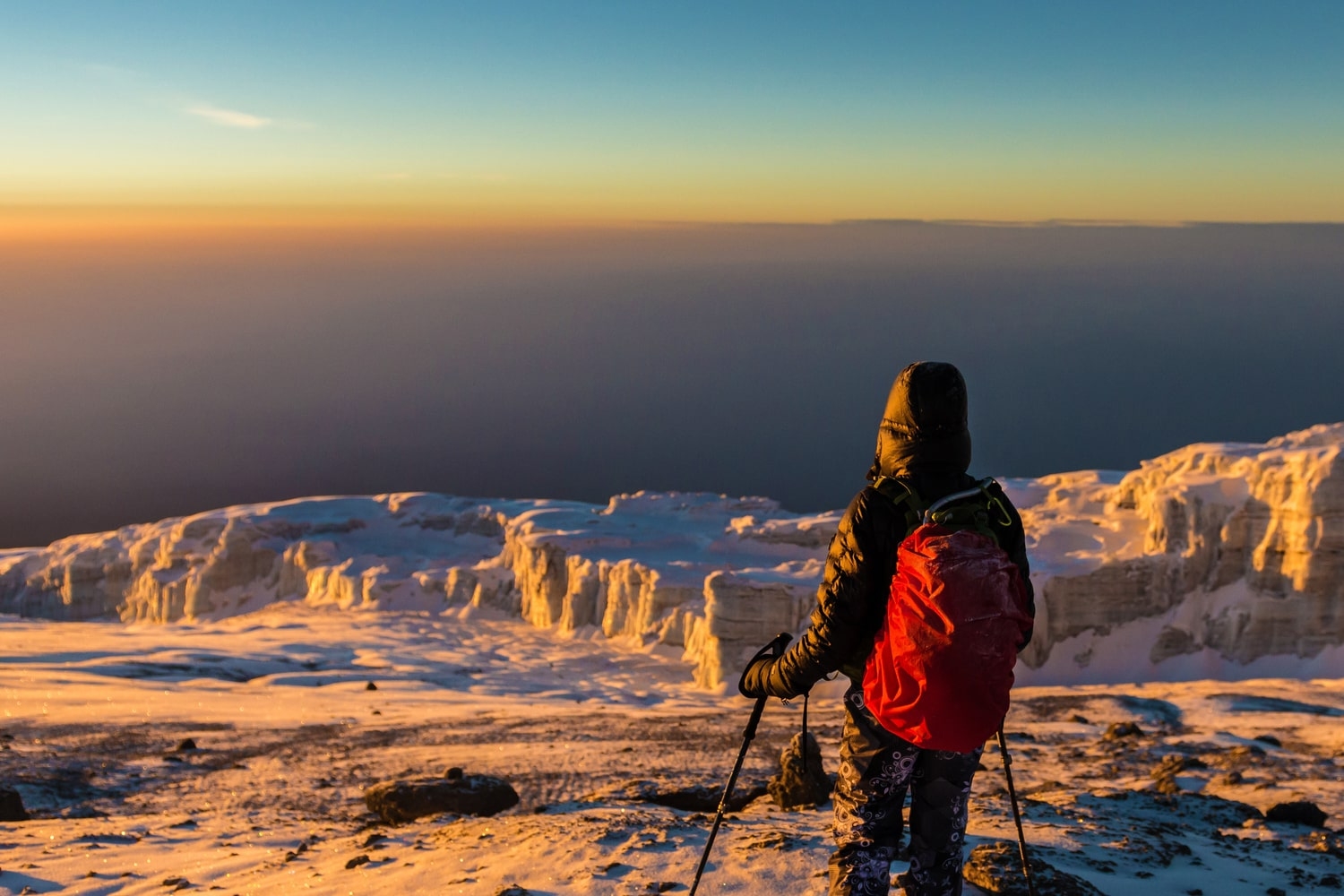
Summit night starts around midnight, and the steep zigzags above the high camp can feel endless in the dark. Watch for sunrise from near Gilman's Point, when Mawenzi glows in the first light behind you.
Descending a different way
Rongai climbers descend the Marangu route, passing Horombo Hut and exiting at Marangu Gate on the southeastern side. This means you see two quite different sides of the mountain, and it is a good idea to arrange a vehicle transfer from Marangu Gate in advance.
Frequently asked questions
Is Rongai easier than Machame?
The daily walking is generally more gradual, with no equivalent of the Barranco Wall. Summit night, however, is just as demanding, and the route has less of the climb-high, sleep-low pattern unless it includes Mawenzi Tarn.
Will I see wildlife on Rongai?
Sightings are limited on any Kilimanjaro route. Colobus monkeys are possible near the forest, and you may see birds such as ravens and sunbirds, but this is not a wildlife trek.
Which months suit Rongai best?
It works year-round and is a favorite during the rainy seasons. In the main dry months it remains a quieter alternative to the popular southern routes.
